Do Filipino Travellers Need a Return Ticket at Check-In?
Yes, plan on being asked. Airlines check onward travel at check-in because they cover every cost if your destination refuses you entry, and Philippine departure formalities list a round-trip ticket for tourists. A confirmed reservation with a real six-character PNR satisfies both checks, from PHP 849 for two days.
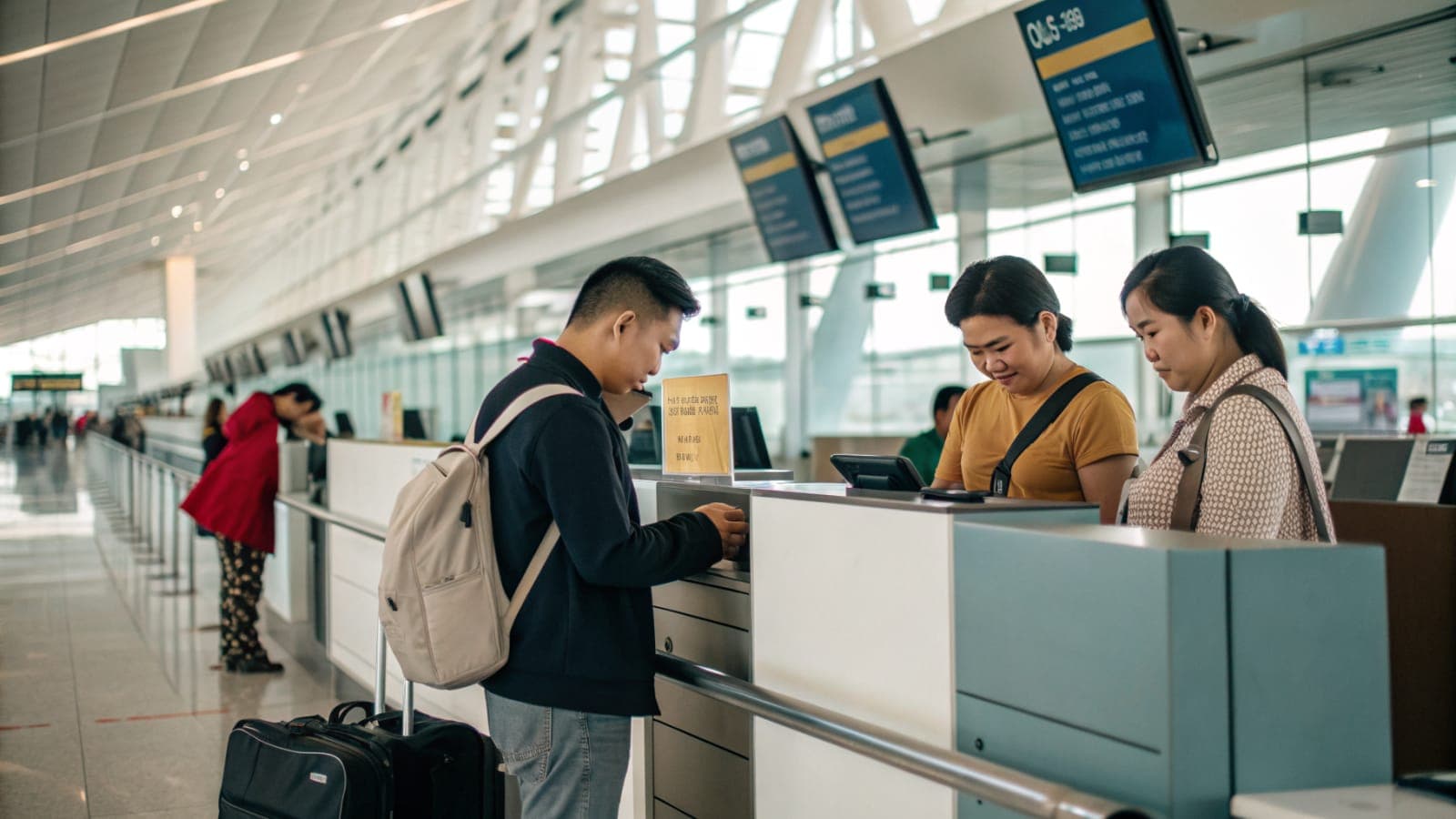
Yes, expect to be asked. Filipino passport holders are routinely asked for a return or onward ticket at the airline check-in desk, and Philippine immigration asks to see one again on the way out of the country. A confirmed flight reservation satisfies both checks, and it does not have to be a paid ticket you intend to fly.
Do airlines really check for a return ticket at check-in?
Yes, and the check is built into the screen the agent is already looking at. Airlines read destination entry rules from IATA's Timatic database during check-in, and that entry tells the agent what your destination expects from a Philippine passport holder on your type of stay. If the rule says onward or return travel is required, the agent has to see something before issuing a boarding pass.
A round-trip ticket on a single booking sails through, because the return sits in the same record the agent already has open. The questions start with one-way tickets, open-ended trips, and itineraries where you plan to leave by bus, ferry or train. That is where most Filipino travellers get held up.
The agent is not judging your intentions or your finances. They are clearing a required field, and a retrievable booking reference clears it.
Arguing the rule at the counter rarely helps either, because the agent cannot override what the entry says. We go through the desk conversation step by step in our guide to using a dummy ticket at airport check-in.
Why are Filipino travellers asked for onward travel more often?
The biggest reason is that Filipino travellers pass through two checks instead of one. Philippine immigration asks for a round-trip ticket on departure under its own departure formalities, and the destination's rule is then checked separately by the airline. Travellers on passports with wide visa-free access usually only meet the second check.
The second reason is the shape of the trip. A large share of Filipino travel is multi-country, open-ended, or built around work and family visits, and those plans produce exactly the one-way and one-leg bookings that prompt a question at the desk.
The third reason is simply arithmetic on the airline's side. More destinations are visa-required or visa-on-arrival for a Philippine passport than for many others, and visa-on-arrival and visa-free entries are the ones whose Timatic rules most often carry an onward-travel condition.
None of this means your passport is being treated as suspect. It reflects which rule applies to which pairing of nationality and destination, and what the person at the desk can actually see in your booking.
Need proof of onward travel?
A real PNR you can show the embassy or the airline from USD 13, without buying a ticket you might not use.
What is the airline actually checking, and why does it care so much?
The airline is checking whether it will be left holding the bill if your destination turns you away. A passenger refused entry becomes an inadmissible passenger, an INAD in industry shorthand, and IATA states that airlines are responsible for all the associated costs, including meals, accommodation, transport, security, detention and the spoiled seat on the way back.
Government fines sit on top of those costs. IATA puts the penalty in most countries at USD 1,000 to USD 2,500 per case, with some states charging up to USD 10,000 per violation. A 2026 IATA paper to ICAO's Asia-Pacific directors general of civil aviation reported costs per case reaching USD 14,000 in some jurisdictions, plus escort costs of up to USD 4,000.
The volume explains the diligence. That same paper reported that around 50 responding airlines logged more than 111,800 inadmissible-passenger cases in 2024, and 53 per cent of them saw the number rise from the year before. One wrongly boarded passenger is a measurable loss on somebody's budget line.
So the question at the desk is narrow and mechanical. The agent wants evidence that you are not going to become a refusal at the other end, and a booked departure out of the destination is the cheapest evidence there is.
What does Philippine immigration require when you leave the country?
For tourists the published list is short: a passport, a visa where the destination requires one, and a round-trip ticket. That list comes from the IACAT Revised Guidelines on Departure Formalities issued under the Department of Justice and republished by Philippine embassies. Departing passengers also register in the eTravel system before immigration clearance.
Most people never go beyond that list. The Bureau of Immigration has said more than 95 per cent of departing passengers are asked only for the basic documents.
Secondary inspection is the part travellers worry about, and it is a referral rather than a default. An officer may send you for it to screen against trafficking and illegal recruitment, weighing factors such as age, educational attainment and financial capacity, and anyone referred fills in a Border Control Questionnaire.
One point to keep straight: a stricter 2023 revision of these guidelines was announced and then suspended before it took effect, so the longer document lists circulating online were never switched on. Plan around the basic list and bring supporting papers if your trip is sponsored or unusual.
Does a flight reservation count as proof of onward travel?
A live flight reservation counts in most cases, because what is being checked is a booking, not a payment receipt. The rule asks whether you have arranged to leave, and a confirmed reservation held in an airline reservation system is that arrangement in the form the industry reads.
The thing that makes it work is retrievability. A reservation created in Amadeus, Sabre or Travelport carries a real six-character PNR, and that record can be pulled up in the GDS by a check-in agent or an airline office. Our verifiable dummy ticket page explains what that lookup shows.
What does not work is a document with nothing behind it. An edited PDF or a screenshot of a search result has no record to retrieve, and a single lookup ends the conversation badly. We cover the documents that do stand up in this guide to proving onward travel to immigration.
It is also worth being straight about what you are holding. A reservation is a reservation, not a paid ticket, and you should describe it that way if anyone asks directly. You can read more about the product itself on our onward ticket page.
Why can my reservation not be found on the airline's own website?
Because most airline websites only display bookings that have been ticketed. A live unticketed reservation sits in the GDS where the trade looks it up, and it often will not appear in the carrier's public manage-booking page at all. Emirates and Etihad are the usual exceptions.
That catches people out, so it is better to know before you are standing at the counter. Verification here is GDS-primary, which is exactly the channel airline staff and immigration desks use, and the absence of a record on a consumer-facing website says nothing about whether the booking exists.
We wrote up the mechanics of this, including what to say if someone checks the website first, in why a dummy ticket is not always verifiable on the airline's website.
What if the agent at the counter will not accept it?
Stay polite and ask two questions. Ask which entry rule they are applying for your destination, and ask them to retrieve the booking by its six-character reference in the reservation system rather than on the airline website.
That second request is the one that usually settles it, since the public website shows ticketed bookings only. If the agent has already looked there and found nothing, saying so plainly tends to move things along faster than repeating that the booking is real.
If that does not work, ask for a supervisor or for the airline's ticket desk in the terminal, where staff have full access to the record. Allow yourself a buffer at the airport so a five-minute check does not turn into a missed flight.
And if the destination's rule genuinely calls for a ticketed onward flight rather than a reservation, buy the flight. That is rare, but no document gets around a rule that asks for issued travel.
Will I be asked for a hotel booking as well?
It can happen, and it is a separate question from onward travel. Philippine officers may ask a self-funded traveller about accommodation or financial capacity if they refer you to secondary inspection, and some destinations ask for an address on the arrival form.
We only sell flight reservations, so book accommodation yourself through whichever platform you normally use. Keep that confirmation on your phone next to the flight reservation and you have covered both questions.
The two documents answer different things. One shows you have arranged to leave, the other shows where you will be in the meantime, and a check-in agent is almost always asking about the first.
Is buying a cheap throwaway fare a better idea?
It is the same proof at many times the price. A cheap one-way fare you never intend to fly is money you will not see again, and a refundable fare locks up a much larger amount while you wait on a refund process you do not control.
A reservation costs a fraction of either. Pricing is USD 13 for a 2-day reservation, USD 19 for 7 days and USD 21 for 14 days, which in pesos is PHP 849, PHP 1,199 and PHP 1,349. Those peso prices are listed on our Philippines page.
Throwaway fares also carry a risk people forget about. Airlines can and do cancel the rest of an itinerary when a passenger no-shows for a flight, so a discarded leg on a real ticket is not always free of consequences.
How long should the reservation stay valid?
Match the validity to the moment somebody will look at it. For a check-in desk or an immigration counter, where the document is read on the day you travel, the 2-day reservation is enough.
For a visa application, pick a window that covers the processing time rather than the travel date. The 7-day and 14-day options exist for that, and a reservation that has lapsed by the time an officer opens your file is worth nothing.
Each reservation is created in the GDS and emailed to you within minutes, so there is no need to buy one weeks early. Buying it close to the date you need it is usually the better call.
Check the dates on the reservation when it arrives. The flight date should sit inside the permitted stay for your destination, since an onward flight dated after your visa or visa-free period runs out defeats the point of showing it.
What should you do before you reach the check-in desk?
Work out which of the two checks you are facing, and get a document that satisfies both. Five steps cover almost every Filipino itinerary.
- Check the destination's own rule first. Look at the embassy or immigration website for your destination, since the airline is reading that rule and not inventing one.
- Decide how you are leaving. If your exit is by land or sea, or not booked at all, you will need a document for the desk even on a flexible trip.
- Get a reservation with a real PNR. A booking that can be retrieved in Amadeus, Sabre or Travelport is the only kind that holds up to a check.
- Keep it in both forms. Carry a printed copy and a copy on your phone, because counters and immigration halls differ on what they want to handle.
- Know what you are holding. If you are asked whether it is a ticket, say it is a confirmed reservation. If an agent checks the airline website and finds nothing, point them to the PNR.
Officers can and sometimes do phone a carrier instead of checking a screen, and that goes fine when the record is genuine. We explain that process in can border officers call airlines to verify tickets.
Where can Filipino travellers get a flight reservation?
We sell one product: an unticketed flight reservation with a real six-character PNR created on Amadeus, Sabre or Travelport, emailed to you within minutes. It is used for visa applications, airline check-in, proof of onward travel and immigration checks, and nothing else is bundled into it.
Prices in pesos are PHP 849 for 2 days, PHP 1,199 for 7 days and PHP 1,349 for 14 days. If you also need travel insurance, email us and we will arrange it on request.
If you are flying out of Manila, Cebu or Clark this week on a one-way booking, get the reservation sorted before you pack. Start on the Philippines pricing page and pick the validity that matches when the document will be read.
Frequently Asked Questions
Written by
Ammar Afridi
Marketing Executive
Ammar Afridi has spent four years preparing travel and visa documentation for UAE residents, working on Schengen, UK, US and Canada files and handling more than 2,000 applications.
Onward ticket
From USD 13
A real flight reservation with a verifiable PNR, delivered by email in minutes.
Get your ticket